|
|
| Prescription Drug Price Increases |
|
|
As you saw last week, I joined my colleagues on the House Committee on Oversight and Government Reform to question Heather Bresch, CEO of EpiPen distributor Mylan, about the drastic price increases of the life saving medication.
This week, I wrote an article in The Hill explaining what I believe needs to be done to address the rising costs of EpiPens, as well as other medications in the United States. I hope you will take a few moments to read my thoughts about this very important issue.
The man behind the curtain in drug price increases
More so than most issues we deal with in Washington, health care is personal. We all feel it when something changes in our health care system. No one is immune, and for some, those changes mean life or death.
It is very understandable, then, that fluctuation in drug prices draws so much public attention. Lifesaving medications are not a choice for a family relying on them to protect a loved one, they are a necessity.
As a pharmacist for more than 30 years, and the only pharmacist in Congress, I’ve seen firsthand the anguish of families balancing their health care needs with their bottom line. It is indescribably heart wrenching to see a mother decide whether to buy groceries or her child’s medication, or a senior citizen struggle to pay for medicine on a fixed budget.
Often those of us behind the counter are left to answer for factors contributing to increasing health care costs that are completely out of our control, and many times we don’t have the answer.
Similarly, when Heather Bresch, CEO of EpiPen distributor Mylan, was brought before the Oversight and Government Reform Committee to answer for the drastic price increase of EpiPen, she also didn’t have all the answers.
While it makes for attention grabbing headlines and may make those of us on the other side of the dais feel better, hollering at drug manufacturers does not get to the root of the problem.
Why? Consider that, despite a 32% increase in the list price of EpiPens, Mylan claims their average revenues from the product decreased in 2015. If the manufacturer that develops and markets a drug is not benefiting from the increased prices, where is the money going?
To answer this question, it’s time to start paying attention to the man behind the curtain. In the drug pricing equation, that is the Pharmacy Benefit Manager or PBM.
PBMs were conceived to serve as an intermediary between the many facets of the pharmaceutical industry. Through negotiating prices, aggregating purchasing power, and processing claims, they were designed to drive prices down.
Since their creation, however, PBMs have evolved from fiscal intermediaries into companies that dictate the products and providers used by patients to treat their medical conditions. This evolution has resulted in fewer choices in care for patients and the erosion of free market principles that truly drive prices down.
Many PBMs will tell you that they do a great service for their patients, and that they’ve saved their customers millions of dollars on prescription drugs. In reality, it’s hard to understand what value they bring to the health care system at all.
At the same time, PBMs are experiencing remarkable consolidation and growth. The three largest now cover roughly 78 percent of all Americans with pharmacy benefits. In just over ten years, the two largest saw their profit margins increase 600 percent. That is impressive growth in any market but especially so when you consider it happened during the worst financial crisis since the Great Depression.
Even with this outstanding growth though, PBMs don’t invest in consumers like pharmaceutical companies who are putting profits back into research and development resulting in the creation of new, cutting-edge treatments and medications.
In our oversight hearing, we discovered that no one – not even the CEO of the company manufacturing EpiPens - knows how the retail price breaks down along the supply chain.
Ms. Bresch stated repeatedly she does not even know how much goes to the PBM, despite her company being a party to a contract with them. Nobody knows how much PBMs and other middlemen are pinching along the way and most are afraid to ask for fear of retaliation.
For manufacturers and distributors, questioning a PBM could result in their medications being shut out of a formulary list and therefore out of reach of most patients.
Many pharmacists are afraid to say anything because they have seen their colleagues suffer harassment and retaliation for daring to question a PBM’s business practices.
While there are good and bad actors in any line of business, the lack of transparency in PBMs limits our ability to separate the wheat from the chafe or enact much needed reforms.
Patients deserve to know if the price increase of EpiPens, as well as other drugs, is due to supply issues or if they’re due to deceptive business practices benefitting PBMs.
It is time for patients to be given the truth about drug pricing increases. It’s time for PBMs to step out from behind the curtain. |
| From our nation's capitol LXXXIV |
|
|
Monday, September 26, 2016: While I’ve had the opportunity to perform the coin toss before high school football games, this weekend was the first time I’ve had the opportunity to perform the coin toss at a college game. Although the coin toss didn’t turn out well for the home team Savannah State Tigers, I am convinced I brought luck to the team as they defeated Bethune-Cookman 16-10 in an overtime thriller to record their first victory over the Wildcats after 16 straight losses.
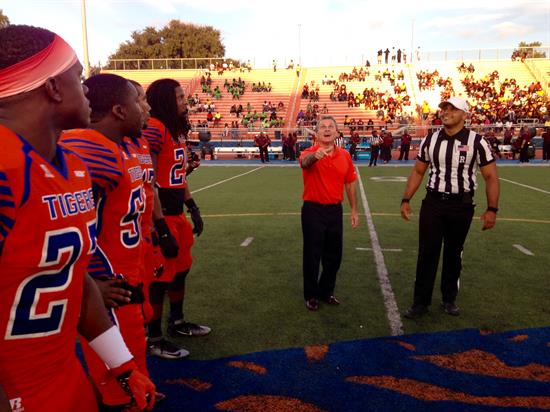
Rep. Carter performs the coin toss at the Savannah State University vs. Bethune-Cookman University football game |
I’m headed back to Washington today in what will surely be one of the most intense weeks that I’ve had in Congress. With the challenge of passing a continuing resolution (CR) to our budget before the end of this month in order to make certain the federal government doesn’t shut down, this should be an interesting next few days. Once back in Washington, we have our weekly Whip Team meeting where we discuss the agenda that lies ahead of us this week, followed by our only vote series of the day where we pass two suspension bills, H.R. 3537, the Dangerous Synthetic Drug Control Act, and H.R. 5392, the No Veterans Crisis Line Call Should Go Unanswered Act. Later in the evening, most of us are glued to our televisions as, like many Americans, we watch the first debate between presidential candidates Hillary Clinton and Donald Trump.
Tuesday, September 27, 2016: Our weekly Republican Conference meeting is this morning and we have plenty to discuss with the week that lies ahead. Of course, the CR is the main topic of discussion and, while many people think it is a simple extension of the current budget, it is of course, much more than that. Within the CR discussion lies the issue of funding to combat the Zika virus, which was held up by the Senate Democrats before our August district work period, funding for flooding victims in Louisiana and other states facing natural disasters, and funding to help the 100,000 people in Flint, Michigan, who face lead-contaminated drinking water in what many legislators are calling a man-made disaster. While nothing is ever easy in Washington, this is especially true when it comes to the budget. After this spirited and sometimes continuous meeting, I head back to my office for a constituent phone call followed by our weekly staff briefing. All staff briefings are important but this one takes on more importance as the next few days are going to be fast and furious and we all need to be on the same page. Afterwards, I head to the House Chamber where I deliver a one minute memorial to lifetime Savannah resident Hal Murray, who passed recently. A link to my speech can be found here.
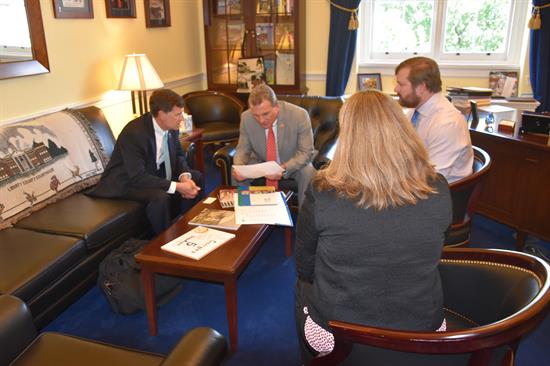
Rep. Carter meeting with the Children's Hospital Association |
Later, I meet with representatives from the Children’s Hospital Association, a group that represents 220 children’s hospitals around the country. Next, I head to the House Chamber where we have our first vote series of the day, before heading back to my office for a meeting with representatives from the Georgia General Contractors of America. Chief among this group’s concerns is workforce development as a well prepared workforce is crucial to their industry. After more constituent meetings, I head back to the House Chamber where we have our second vote series of the day and pass the CO-OP Consumer Protection Act. Afterwards, I stay in the House Chamber for the next two hours and preside as Speaker Pro-tem during amendment debate on H.R. 5303, the Water Resources Development Act (WRDA). WRDA is an extremely important bill that addresses the needs of our country’s harbors, locks, dams, flood protection, and other water resources infrastructure that is critical to our nation. Of course, with two major sea ports in the First Congressional District in Savannah and Brunswick, WRDA is very important to us.
Wednesday, September 28, 2016: Washington is full of rumors but the chatter that has been going on for the past day or so is enormous even for Washington. Finally, we see some movement this morning as we receive word that a deal has been struck by leadership. My morning starts early as I travel across Washington to the other side of town to address the National Association of Specialty Pharmacy at their annual meeting. The group includes more than 1600 professionals and while they are primarily interested in health care issues, they also are eager to hear about where we are with the pending government shutdown.
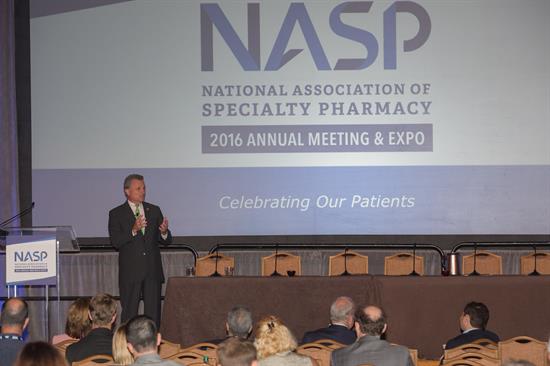
Rep. Carter Speaking to the National Association of Specialty Pharmacy |
Afterwards, I head back to the Capitol and my office for a meeting with new Georgia Southern University (GSU) President Jaimie Hebert and other representatives to discuss the exciting progress the university is making. Next, I meet with representatives from Blink Health, a pharmacy start-up that allows for online transactions for a low, fixed price that are then picked up at local pharmacies. After attending the weekly meeting of the conservative Republican Study Committee, we receive word that the Senate has passed a CR and would be sending it over to the House today. While most bills must adhere to a 3 day rule, the rule has been waived by the House Rules Committee and we will be considering it later today. Next, I head to an Information Technology Subcommittee meeting of the House Committee on Oversight and Government Reform on cybersecurity and ensuring the integrity of the ballot box. Although I don’t serve on this committee, I have requested to participate today as Georgia’s Secretary of State and my good friend, Brian Kemp, is testifying. Afterwards, I head down to the House Chamber for our first vote series of the day where we sustain the veto of S. 2040, the Justice Against Sponsors of Terrorism Act. Earlier, the Senate had sustained the veto by a vote of 97-1 and today we sustain it by a vote of 348-77, making this the first veto override of President Barack Obama’s presidency. After a meeting with the Georgia Independent Auto Dealers Association and later representatives from ConocoPhillips, I return to the House Chamber for our second vote series where an amendment to WRDA authorizing funding for Flint, Michigan, that I did not support, passes and then the WRDA bill, that I did support, passes. Afterwards, I remain on the floor to speak in favor of H.R. 6094, a bill that will delay the implementation of the administration’s overtime rule. Later in the evening, we have our third and final vote series of the day as we pass H.R. 6094 as well as H. R. 5325, the CR that will continue our government running until December 9th.
Thursday & Friday, September 29 & 30, 2016: Although we are unexpectedly out of session today, I remain in Washington for a number of television and print interviews during the morning primarily dealing with prescription drug price increases and last week’s OGR hearing that I participated in questioning the CEO of EpiPen distributor Mylan about the drastic price increases of the life saving drug. Later in the afternoon on Thursday, I fly to Atlanta where on Friday morning I participate in more television and print interviews on the same subject. |
|
|