|
|
|
|
For Immediate Release |
Contact: Mary Carpenter |
|
|
10/28/2015
|
202-834-0386 |
|
|
Opening Statement: Carter at Education and the Workforce Committee Markup of the Protecting Local Business Opportunity Act |
|
|
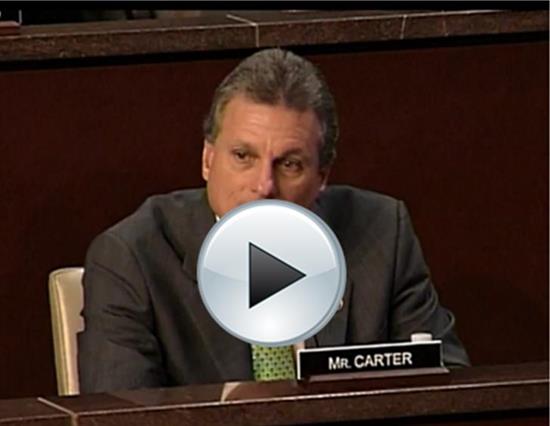
Washington, D.C. - Congressman Earl L. "Buddy" Carter (Ga-01) delivered the following remarks during the House Education and the Workforce Committee's consideration of H.R. 3459, the Protecting Local Business Opportunity Act.
Remarks as Delivered:
Thank you, Chairman Kline, and thank you for convening today’s markup of H.R. 3459, the Protecting Local Business Opportunity Act. Before I explain the technical changes included in the substitute amendment, I’d like to discuss the importance of this issue more broadly.
As a small business owner, I can attest to the many challenges that men and women across the country face in their efforts to establish and grow successful small businesses. In recent years, as our economy has struggled to recover, these individuals have had to work particularly hard to stay afloat and have sacrificed a lot to keep their doors open. It hasn’t been easy, but as many of them will say, it’s been worth it.
They’re proud of the opportunities they create for their employees and the services they provide to their communities. For them, owning a small business is about much more than generating an income or making a profit. As policymakers, we should do everything we can to encourage these hardworking men and women and to protect them from actions that threaten their livelihoods and the livelihoods of their employees.
Unfortunately, the bureaucrats at the National Labor Relations Board are once again engaged in an effort that will deal a serious blow to small businesses. Expanding the joint employer standard not only threatens a small business owner’s ability to run his or her own business, it also makes it harder for future entrepreneurs to do the same. Some have said that the board’s decision has been blown out of proportion, but the small business owners we’ve heard from tell a different story.
Just a few months ago, my colleagues Dr. Roe and Mr. Allen joined me in Savannah to hear from some of our local small business owners who have serious concerns about what an expanded joint employer standard means for them. They discussed logistical challenges, legal confusion, and various economic hardships that could lead to lost jobs and store closures.
Two small business owners we heard from, Kal Patel and Alex Salgueiro, are first generation Americans. They explained how their families immigrated to the United States in pursuit of the dream of becoming small business owners. They are both very proud of what they have accomplished, as they should be. But they’re also afraid that the NLRB’s new joint employer standard will devastate their industries and that their employees will suffer as a result.
Another small business owner we spoke with, Fred Weir, said he believes an expanded joint employer standard has “almost unlimited destructive capacity” and “will drain the life from the hundreds of thousands of small businesses” like his. He’s concerned that the new standard will not only undermine how he runs his business, but that it will also threaten the jobs of those in what he calls his “employee family.”
These are just a few of the inspiring stories and a handful of the troubling concerns we’ve heard during the past several months. The Protecting Local Business Opportunity Act will provide certainty to these small business owners. It will allow them to continue making contributions to local economies, and it will enable others to someday do the same. We cannot allow a few bureaucrats at the NLRB to continue squeezing our nation’s small businesses until they are forced to close their doors. We have a responsibility to act in the best interests of American workers and job creators, and that’s why passing this legislation is so important.
The technical change in the proposed substitute amendment simply clarifies a reference to “employer” in the original legislative text. I urge my colleagues to support the substitute, as well as the underlying bill, and I yield back the balance of my time.
Click here to view Carter's opening statement.
###
|
|
|