|
|
| Obamacare for Financial Planning |
|
|
This week the Obama administration released the Department of Labor's final "fiduciary" rule. The administration claims the rule will help those trying to save for retirement when, in reality, this new disastrous regulation will make it harder for hardworking Americans and families to get financial advice and threatens the ability of small businesses to provide their employees with this vital resource.
Under the new rule, financial professionals who provide even one-time guidance on investments could find themselves classified as fiduciaries. This means that small portfolios could now be considered too small to justify the cost for brokers so they will simply stop servicing them, leaving middle class Americans in the dark on financial advice.
This regulation is so bad that many are calling the fiduciary rule Obamacare for financial planning because it will require an enormous amount of paperwork, is another one-size-fits-all regulation forced on Americans, and will result in higher costs and fewer options. Experts estimate that Americans stand to lose $80 billion in retirement savings annually because the rule deters companies from serving middle-class savers creating a guidance gap.
Remember during the Obamacare debate when Americans were told if you like your doctor you could keep them? Well we all know that turned out not to be true for many and this will result in the same loss of trusted brokers for low- and middle-class savers.
The House has already passed legislation to delay this rule and my colleagues and I on the House Committee on Education and the Workforce passed legislation providing responsible alternatives to this irresponsible regulation. Member of Congress from both sides of the aisle have expressed serious concern and we are committed to working together to prevent implementation of this terrible rule.
|
| From our nation's Capitol LX |
Monday, April 4, 2016: I’m traveling this week as a member of the Congressional Study Group on Europe to Switzerland. This mission is organized in cooperation with the Swiss Embassy in Washington, DC, on behalf of the government of Switzerland, and is in no way funded with American taxpayer funds. I am one of five Members of Congress attending and, since Switzerland is six hours ahead of Eastern time, I have quite a case of jetlag. Because we are only here for three days, we hit the ground running and our first meeting is with the U.S. Ambassador to Switzerland, Suzan LeVine, and the Swiss Ambassador to the U.S., Martin Dahinden.
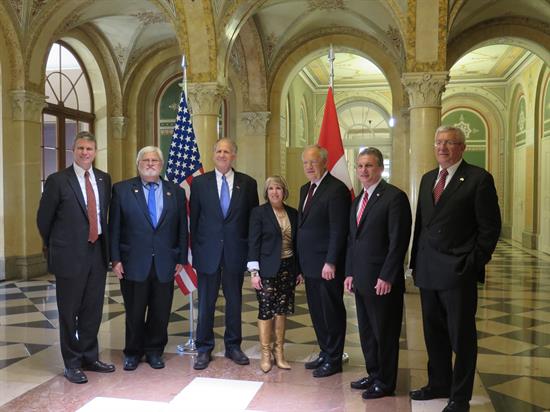
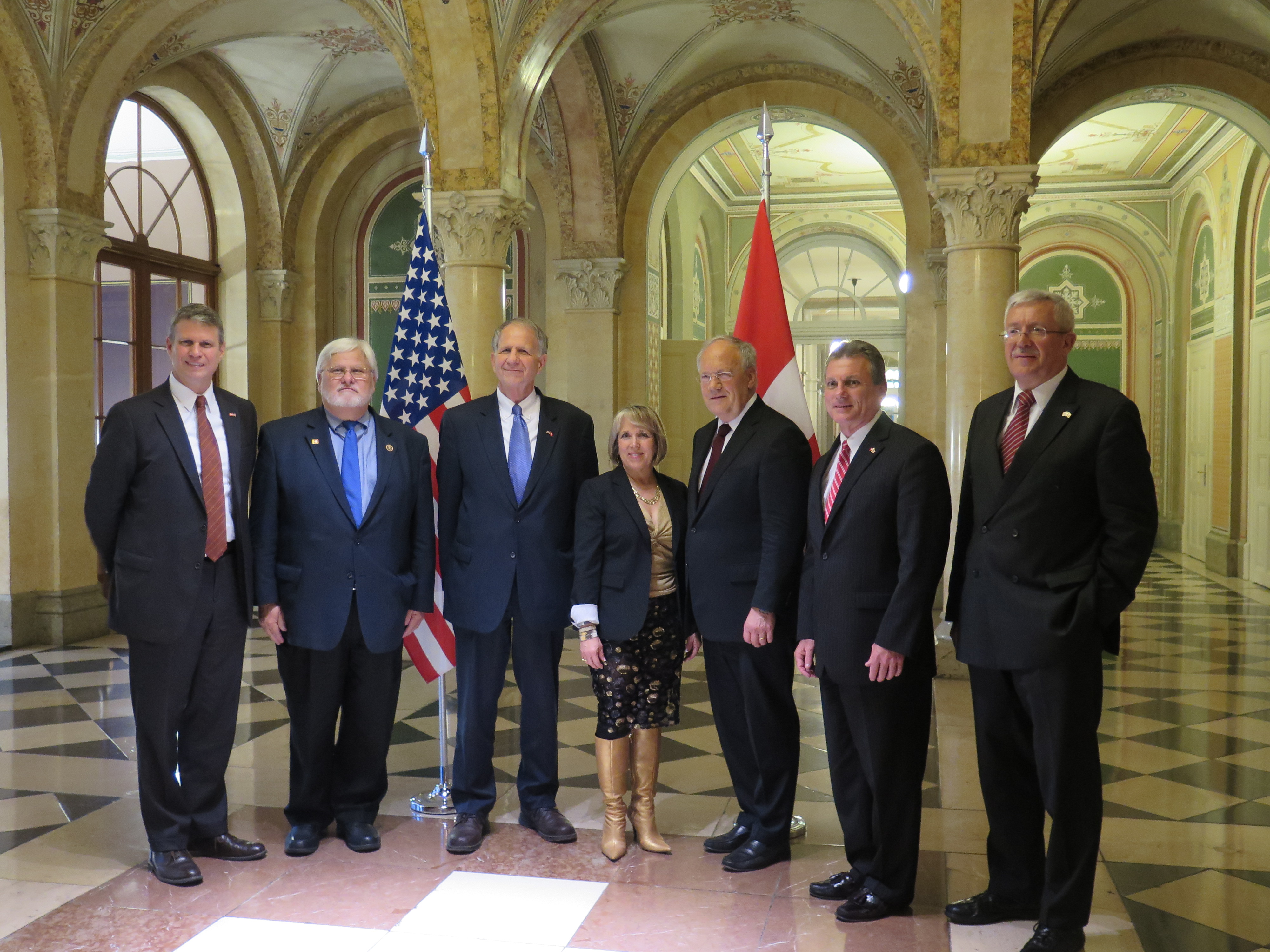
Congressman Carter and the delegation in Zurich |
While this meeting is a general overview of where we will be visiting and who we will be meeting with on this trip, we also have the opportunity to discuss some of the issues currently impacting Switzerland. Chief among the concerns are immigration, the value of the Swiss franc, and trade. While Switzerland is not a member of the European Union (EU), because of its geographical location, it has a close relationship with the EU and has over 120 bilateral agreements with the EU. Switzerland is also the 7th largest foreign direct investor in the U.S., and Swiss companies create around half a million jobs in the United States. Our next stop is a visit to ETH Zurich, Switzerland’s leading university for technology and the sciences where we discuss immigration challenges facing the university and how they can continue to attract the best talent. We also have the opportunity to visit the digital fabrication lab where we witness the cutting edge work the university is doing with robotics. Finally, we visit the Center City Campus where we hear of the role of vocational education and apprentices within the Swiss education system. Our final meeting of the day is with members of the Swiss-American Chamber of Commerce as we discuss with CEO’s of Swiss companies the potential of Switzerland as a business location.
Tuesday, April 5, 2016: While Zurich is the largest city in Switzerland, the capital is located in Bern and we head out this morning on the two hour train ride to the capital.
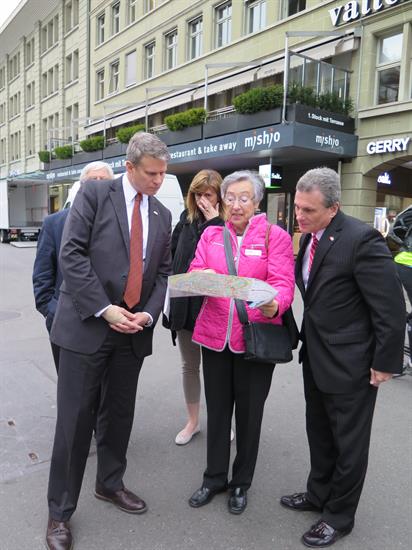
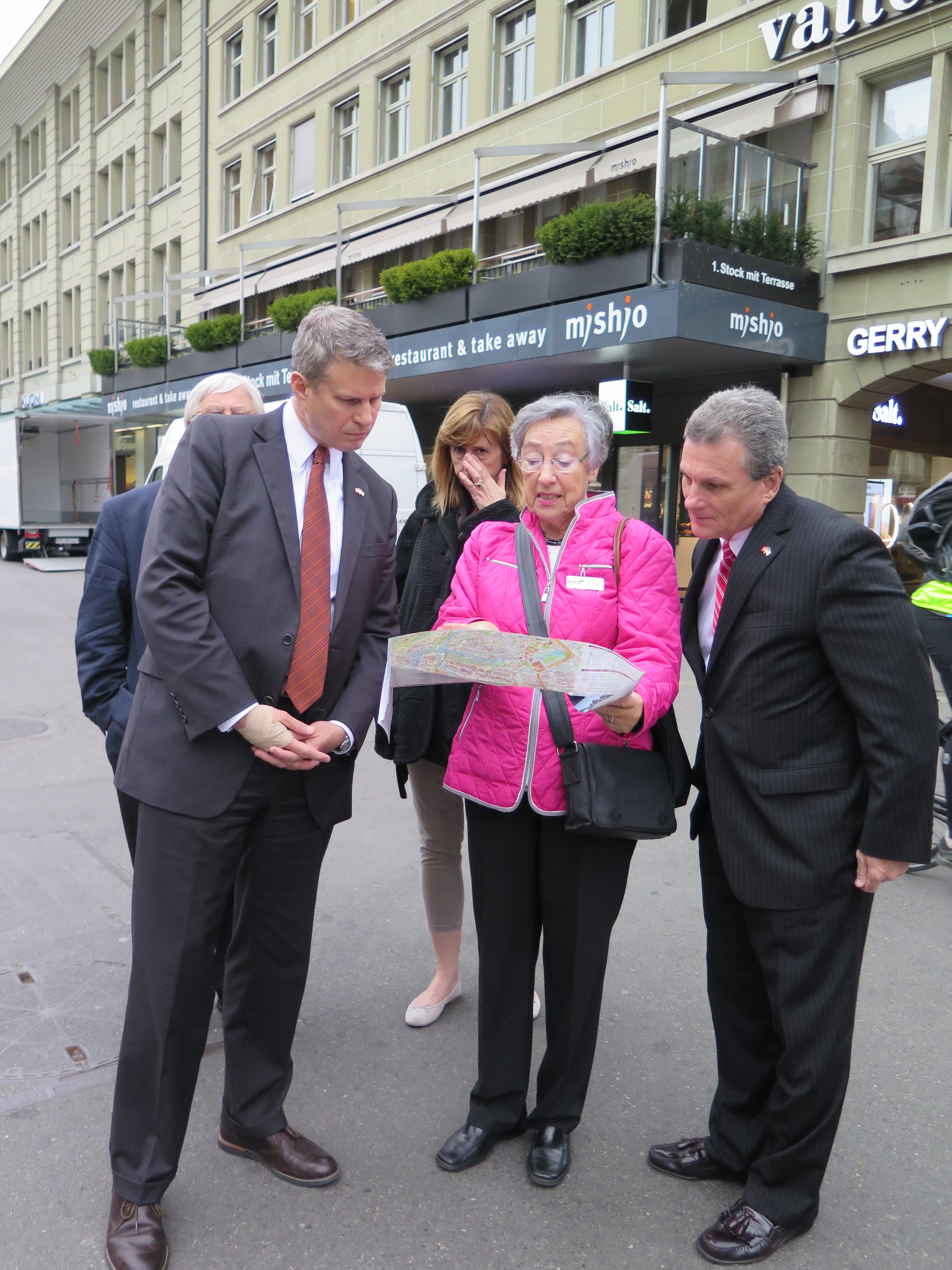
Congressman Carter in Bern |
Unlike much of the U.S., Switzerland and Europe depend largely on mass transit for transportation. Trains connect most of the cities in the area and trams are plentiful in the downtown areas. Our first meeting this morning is with Martin Seiler, head of the Federal Intelligence Service, who brings us up to date regarding the European immigration crisis, the fight against terrorism and the impacts on Switzerland’s security policy. One of the biggest surprises that I noticed in Switzerland was the lack of visible security throughout the country, particularly at the airport and at the Capitol. Although I realize that Switzerland prides itself on being a neutral country, there were no armed guards at the airports or at the entrance to government buildings. With the recent terrorist attacks in Brussels and Paris, I was expecting the opposite. Another interesting fact that I learned is that when Parliament passes a law, the citizens of Switzerland can call for a referendum on the law by obtaining 50,000 signatures and a vote is taken as to whether the citizens want to accept the law or not. This was the case with immigration as Parliament originally passed a law that said there would be no limits on immigration and a referendum was held last year overruling the law and calling for limits to be set by Parliament. Recently, Parliament passed a law calling for more security measures and broader powers of information gathering by the government. Similar to us in the U.S., many citizens are concerned with privacy issues and this law will be presented before the voters in the fall in a referendum for approval or denial. Our next meeting is with Ambassador Eduard Gnesa, Special Envoy for Migration with the Federal Department of Foreign Affairs. Throughout our visit immigration seemed to be the primary issue on the minds of the leaders we met. While Switzerland appears to want to do their part in the migration crisis that Europe is experiencing, they also are very concerned about accepting too many people into their country and the impact it would have on their job market. Next we meet with National Councilor Corina Eichenberger-Walther, President of the Security Policy Committee.
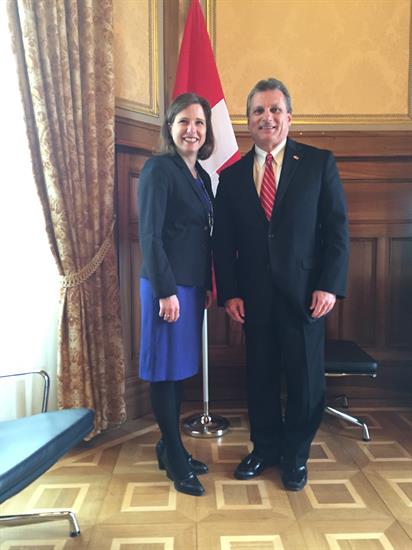
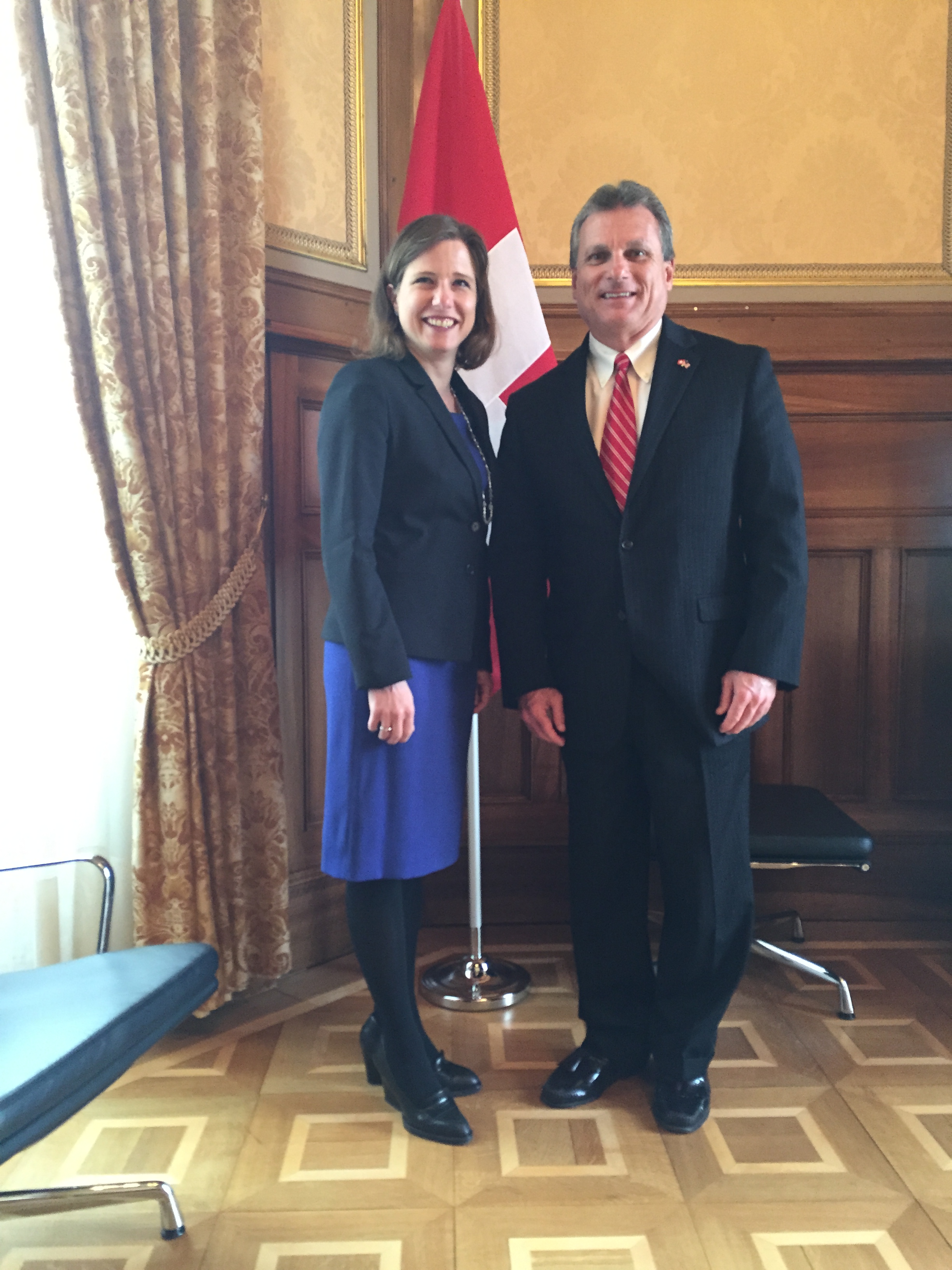
Congressman Carter with President of the National Council Christa Markwalder |
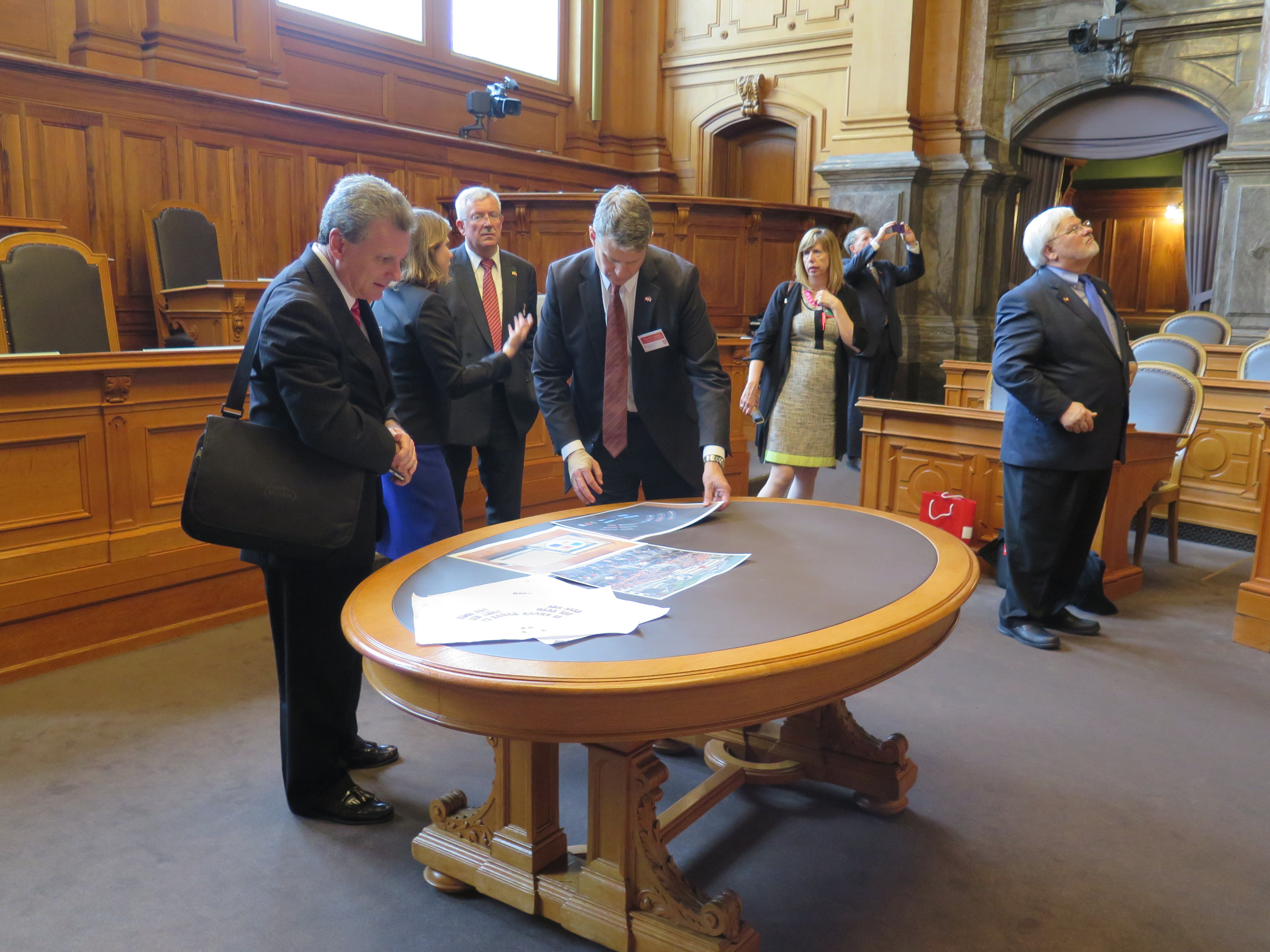
Since a National Councilor is very similar to being a Member of the U.S. House of Representatives, we found the discussion here to be most interesting as we compared our offices and responsibilities. Afterwards, we have a tour of the Swiss Parliament led by the President of the National Council, Christa Markwalder. This was quite fascinating as we learned not only of the history of this great country but of the daily operations of the two bodies of Parliament.
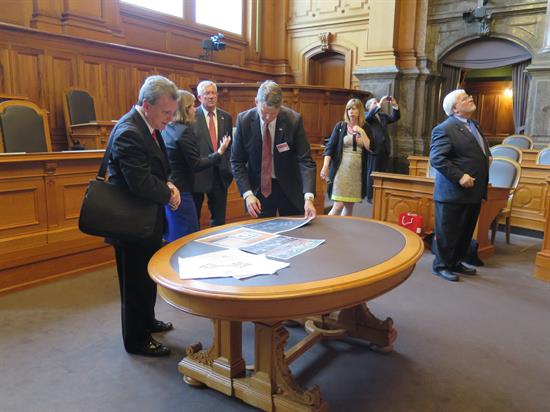
Congressman Carter in a Chamber of the Swiss Parliament |
Unlike the U.S. where we have only two major parties and one national language, Switzerland has over seven parties and recognizes four national languages- German, French, Italian and Romansh. After our tour of the Parliament, we meet with the President of the Swiss Confederation, Johanna N. Schneider-Ammann, where we discuss security and immigration issues. Aside from the two bodies of Parliament, Switzerland has a National Confederation, made up of seven positions, that is elected every four years by members of Parliament. Members of the National Confederation alternate areas of responsibility within the government and elect one of their members to serve as President for a term of one year. Later that evening, we visit the U.S. Embassy for another meeting with U.S. Ambassador Suzan LeVine.
Wednesday, April 6, 2016: After spending the night in Bern, our first meeting this morning is with three Swiss journalists as we discuss immigration, security and other issues common to our countries, followed by a long bus ride to the city of Weggis to visit Thermoplan AG, a highly specialized coffee equipment manufacturer used by Starbucks and other worldwide companies. This impressive facility gives us a sense of the innovation of the Swiss in a competitive global environment. After another long bus ride back to Zurich, our final meeting of the trip is with representatives of the think tank Avenir Suisse. These business and government leaders provide all of us with lively discussion on various issues including immigration, the Swiss franc, trade deals and, of course, the current U.S. Presidential campaign. After spending three days in this beautiful country, I found the concerns of the Swiss to be eerily similar to those of most Americans- immigration and the impact it will have on jobs, their economy and safety, individual privacy vs. the need for better security, the strength of their currency and the need for other countries to value their currency properly, foreign trade and future trade pacts such as TTIP, education and the need for skilled workers for the future, to name a few. Much like America, Switzerland understands that it must change as the world around it is changing. However, the Swiss are discovering that change is never easy and seldom is it fun. The Swiss are a great people and they are friends to America.
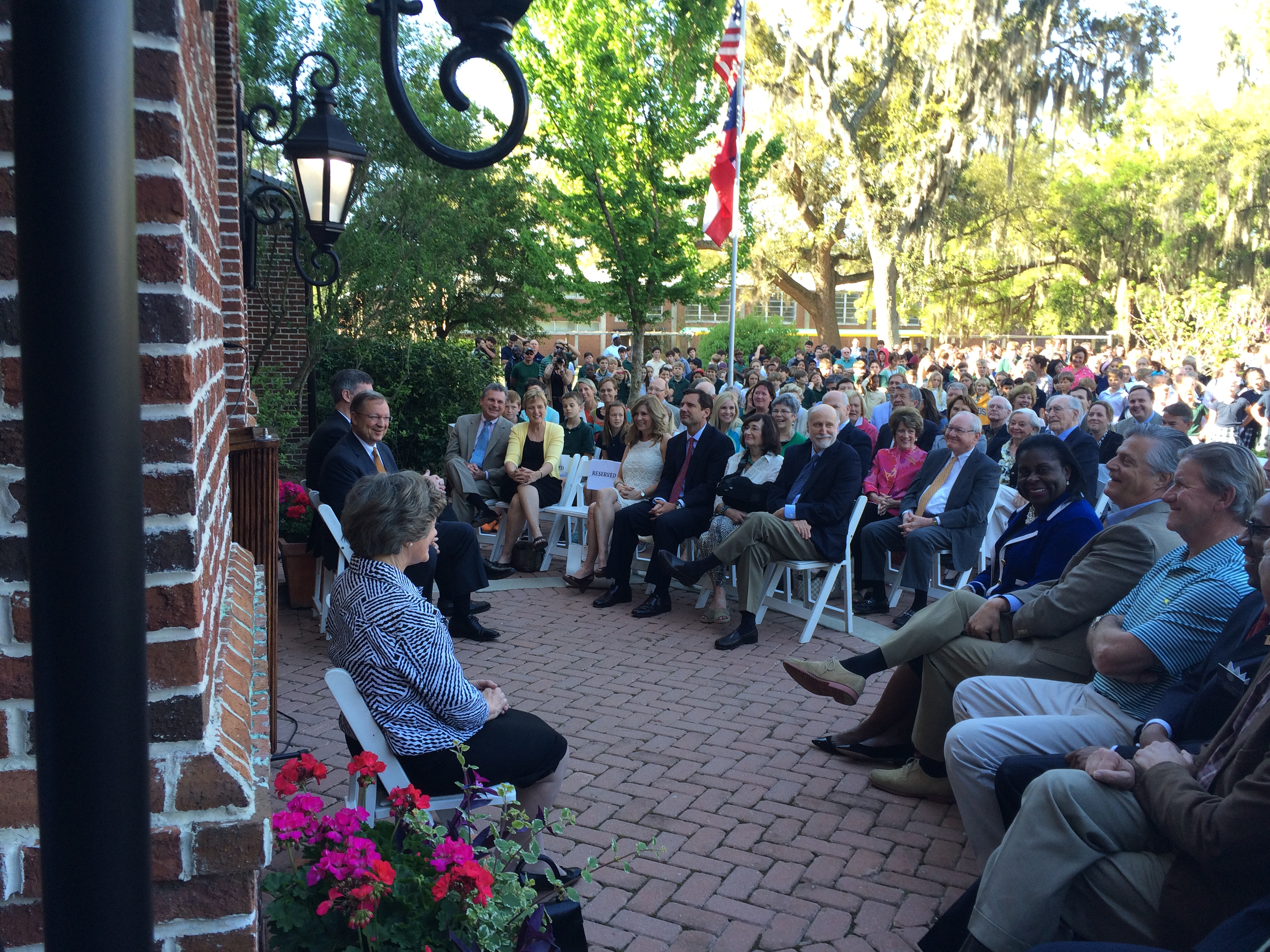
Friday, April 7, 2016: After a travel day home yesterday, I’m back in the district this morning bright and early with the Band of Brothers Bible study in Garden City. Next, I head to Savannah Country Day School for the naming of Pressly Hall in honor of Headmaster Emeritus Paul Pressly. Dr. Pressly is well deserving of this honor for his years of service to the school and the impact he has had on the many students who have come through the great institution.
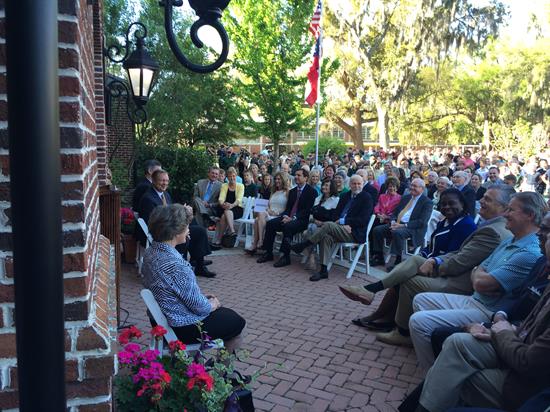
Congressman and Mrs. Carter at the naming of Pressly Hall |
The remainder of my day is spent in my district office in Savannah meeting with constituents before I head to Guyton Christian Church in Effingham County to participate in the Shaw Wilkerson Outstanding Achievement Award Banquet. |
|
|