Press Releases
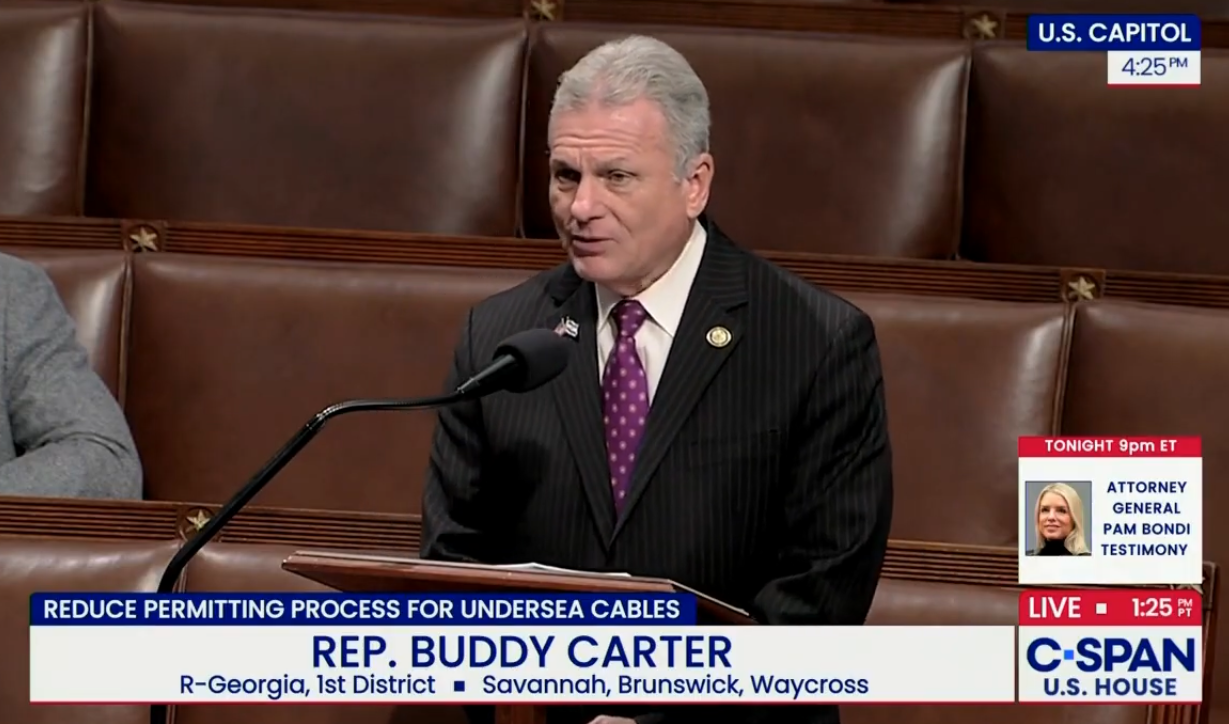
WATCH: Carter champions his Undersea Cable permitting reform bill on House floor
Washington,
February 11, 2026
"Mr. Speaker, I rise in support of my bill, H.R. 261, the Undersea Cable Protection Act of 2025.
"Undersea fiber optic cables carry roughly 95 percent of all intercontinental internet traffic and nearly all transoceanic digital communications.
"Trillions of dollars in financial transactions - trillions! Global trade data, cloud computing, and secure government communications depend on these cables every single day.
"They are critical infrastructure, just as essential as ports, as pipelines, or power grids.
"Yet despite their importance, the United States has allowed overregulation and duplicative permitting to stand in the way of deploying and maintaining this infrastructure.
"Especially on the West Coast, where permitting delays and overlapping approvals have made it effectively impossible to lay new cables in certain areas for decades.
"The [Natural Resources] Chairman [Bruce Westerman] just described what we're talking about here.
"These projects weren’t stopped because they failed environmental review.
"They were stopped because of bureaucracy.
"That is the problem H.R. 261 is designed to fix.
"Today, even when an undersea cable project has already received full authorization from a federal or state agency, it can still be forced through an additional, duplicative permitting process within national marine sanctuaries.
"That extra layer adds years of delay, drives up costs, and discourages investment without providing meaningful environmental protection.
"H.R. 261 clarifies that once a project has been lawfully approved at the state and federal levels, it should not be required to obtain an additional permit for the same activity.
"And let me be clear: This bill does not weaken environmental protections.
"All existing environmental laws, reviews, and interagency coordination requirements remain fully intact.
"This is about eliminating redundancy—not eliminating oversight.
"This matters for states like Georgia.
"Georgia’s economy depends on global connectivity, from the Port of Savannah and our logistics and supply chain networks to manufacturing, defense contractors, data centers, and a growing technology sector.
"Reliable undersea cable infrastructure supports jobs, it supports trade, and economic growth across the country.
"There is also a serious national security component to this.
"Undersea cables carry sensitive government and military communications.
"Delays in installing, repairing, or maintaining this infrastructure create real vulnerability to our national security.
"Even today, our adversaries like China are actively targeting global communications networks, especially cutting undersea cables that connect us to our allies like Japan, Korea, and Taiwan.
"Secure, resilient connectivity is not optional; It is a strategic necessity.
"H.R. 261 is the solution that offers a balanced, commonsense solution.
"It cuts unnecessary red tape, it preserves environmental safeguards, it strengthens our economy, and most importantly, it protects America’s national security.
"I implore this Congress to pass this legislation to secure America’s technological dominance and fortify our national security."
|